




Last Updated: 9/25/2026
Author: James Zhao, Sr. Tech Specialist & Alex Park, Product Specialist
Every dishwasher claims to clean better, run quieter, or last longer. The specs are how you check. When deciding what to look for in a dishwasher, start with five numbers: noise in dBA, capacity in place settings, tub material, drying method, and yearly energy use on the EnergyGuide label.
Below, our product team explains what each spec means, what it costs you in tradeoffs, and how the features work together. We use real numbers from the built-in and in-sink dishwashers we design, so you can see what a good spec sheet looks like.
Key Features to Look out For
Start with the features. Once you know what matters to you, picking a type gets easier.
Cleaning Power & Performance
Clean dishes come from water pressure, water heat, and a sensor that knows how dirty the load is. Look for:
- Full spray coverage. More spray arms means fewer blind spots. Our built-in uses 4 spray arms, and our in-sink models spray 360°.
- A soil sensor. Also called a turbidity sensor, it checks how dirty the wash water is and adjusts time and water to match. A lightly soiled load gets a shorter, lighter wash. Pair it with an Auto cycle.
- Hot water. Heat breaks down grease. Water reaches 167°F in all of our dishwashers.
- Cycles you'll use. Normal, Intensive, Quick, and ECO cover most homes. ECO saves energy by washing cooler for longer, so it's often the slowest cycle.
A sanitize claim means more when someone else tested it. The main standard is NSF/ANSI 184, which requires a 99.999% bacteria reduction and a 150°F final rinse (NSF). Some brands publish third-party lab results instead. Our built-in reached a 99.99% sanitization rate in ETL third-party testing.
Loading Flexibility
Capacity tells you how much fits. Rack design decides whether your dishes actually fit. Look for:
- An upper rack that raises or lowers, so tall glasses fit on top or tall pots fit below
- Fold-down tines for pots, mixing bowls, and sheet pans
- A third rack if you run full loads of utensils. It frees up the silverware basket space, but it can take height from the upper rack.
- A max plate size that fits your dinnerware. Our in-sink models take plates up to 10 inches.
Noise Level
Noise is listed in dBA, decibels measured the way people hear. Use this as a guide:
- 44 dBA or lower: Quiet, about like moderate rain. The quietest models get down to about 38 dBA.
- 45 to 50 dBA: About the level of a normal conversation. You'll notice it in an open floor plan.
- 51 dBA and up: Average. Similar to a refrigerator, and louder at the top of the range.
Every 10 dB sounds about twice as loud, so a few numbers matter. Insulation, a stainless tub, and the filter all play a part. Self-cleaning filters use a grinder (often called a hard food disposer) that adds noise. Manual filters run quieter but need a rinse about once a month.
Where it sits matters too. In an open kitchen or next to a bedroom, pay for quiet. In a closed-off kitchen, a model in the low 50s may be all you need.
Interior Tub Material
Your tub is either stainless steel or plastic, and the choice affects drying, stains, and noise.
- Stainless steel holds heat, which helps dishes dry. It resists stains and odors and adds some sound dampening. Our built-in and in-sink models use stainless steel tubs.
- Plastic costs less and works fine for light use. It can stain from tomato sauce, hold odors over time, and dries less well since it doesn't hold heat.
Drying Method
Drying is where models differ most. Here's how each method works:
- Heating element: Dries fast but uses more energy and can warp plastics on the bottom rack.
- Condensation: Steam collects on the cooler tub walls and drains away. It's quiet and efficient but slower. A stainless tub helps it work.
- Fan-assisted: A fan pushes moist air out so dishes dry faster.
- Auto-open door: The door pops open at the end to let steam escape.
Many dishwashers combine methods. Our in-sink models use hot air, a fan, and an auto-open door. Our built-in pairs PTC heating with fan-driven air circulation and adds an Extra Dry option. Plastic containers may still come out damp in any machine, since plastic doesn't hold heat. Rinse aid helps.
Smart Features and Controls
Good controls save you guesswork. Look for:
- A digital display that shows the cycle and time left
- Delay start, so you can run it overnight or during off-peak hours
- A child lock if little kids can reach the panel
- Leak protection that stops the water if it senses a leak
Our dishwashers include leak protection, and our in-sink models add touch controls with a child lock. Wi-Fi apps are nice to have, not a must.
Energy Efficiency
ENERGY STAR is pass or fail. Under the current limits, standard dishwashers (8 or more place settings) must use 240 kWh or less per year and 3.2 gallons or less per cycle. Compact models (fewer than 8 place settings) must stay at or under 155 kWh and 2 gallons (ENERGY STAR).
One catch: most 18-inch dishwashers hold 8 to 10 place settings, so they're rated as standard models, not compact.
To compare models, check the yellow EnergyGuide label for yearly kWh and estimated yearly cost. Compared with washing by hand, an ENERGY STAR dishwasher uses less than half the energy and saves about 8,400 gallons of water a year. Our in-sink models are ENERGY STAR certified at 155 kWh per year.
Types of Dishwashers You Can Choose From
Your kitchen layout and plumbing narrow the choice fast. Here's how the main types compare:
| Type | Width | Typical capacity | Hookup | Best for |
|---|---|---|---|---|
| Built-in | 24" | 12 to 16 place settings | Permanent water, drain, and power | Most households |
| Compact | 18" | 8 to 10 place settings | Permanent water, drain, and power | 1 to 3 people, tight layouts |
| In-sink | Fits a sink base cabinet | About 4 place settings | Sink water line, drain, 120V outlet | No dishwasher slot |
| Drawer | 24" | About 7 per drawer | Permanent water, drain, and power | Small loads, islands |
| Portable | 18" or 24" | 8 to 12 place settings | Faucet adapter and outlet | Renters who need capacity |
| Countertop | About 16 to 22" | 2 to 6 place settings | Faucet adapter or fill tank | Renters with counter space |
Built-in
Built-in dishwashers install under the counter in a 24-inch opening and hold 12 to 16 place settings. They fit most families and anyone who runs a load every day. Ours holds 12 place settings.
Compact (18-inch)
Compact dishwashers install the same way as a built-in but fit an 18-inch opening. Most hold 8 to 10 place settings. They work well for one to three people or a kitchen that can't give up 24 inches.
In-Sink
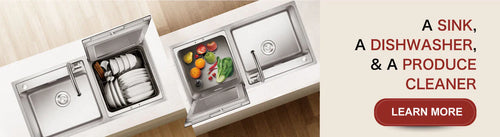
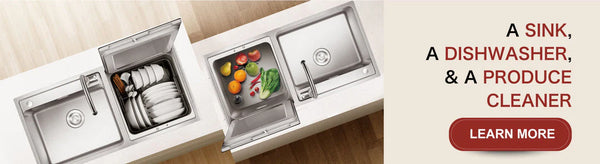
In-sink dishwashers sit in your sink base cabinet and load from the top, so there's no bending. They use the water line and drain already under your sink and plug into a standard outlet. Our VersaWash™ 3-in-1 replaces your sink with a sink bowl, dishwasher, and produce cleaner in a 36-inch base cabinet. The VersaWash™ 2-in-1 sits beside your sink in a base cabinet 22 inches or wider. Both hold 4 place settings.
Drawer-style
Drawer-style dishwashers use one or two pull-out drawers instead of a drop-down door. You can run each drawer on its own, which suits small loads or a second dishwasher in an island. They tend to cost more than a standard built-in with the same capacity.
Portable and Countertop
Neither needs a permanent install. A portable rolls to the sink and holds 8 to 12 place settings. A countertop model sits by the sink and holds 2 to 6. Both hook up to your faucet, which ties it up while the cycle runs. Short on space? See our guide to the best dishwasher for a small kitchen.
Custom Panel-Ready
A panel-ready dishwasher is a built-in that takes a cabinet panel on the front, so it blends in with your cabinets. Budget for the panel, since your cabinetmaker usually makes it. The controls sit on the top edge of the door, so look for a status light that shows when the cycle is done.
Choosing the Right Size Dishwasher for Your Space
Most install problems come from one missed measurement. Before you buy:
- Measure the opening. A standard opening is 24 inches wide, about 34 inches tall from the floor to the underside of the counter, and 24 inches deep. Measure the height at the front and back.
- Check the floor. New tile or flooring can raise the floor and shrink the opening. Adjustable leveling feet cover small gaps. Our built-in adjusts from 33 7/8 to 35 1/16 inches tall for this reason.
- Check door clearance. The door needs room to open all the way. Watch for handles on nearby drawers and for tight corners.
-
Match capacity to your household. A place setting is one dinner plate, salad plate, bowl, cup, glass, and set of flatware.
- 1 to 2 people: 4 to 8 place settings, if you run it daily
- 3 to 4 people: about 12
- 5 or more, or you cook a lot: 14 to 16, ideally with a third rack
- Plan the hookups. You need a hot water line with a shutoff valve, a drain to the sink or disposal with a high loop or air gap (check local code), and a 120V outlet or hardwired circuit. Many built-ins don't include a power cord or water line, so plan on a hookup kit. Ours comes with a 5-foot cord and plug.
Dishwasher Finishes & Design Styles to Consider
Pick a finish that fits your kitchen and how much wiping you want to do. Common options:
- Stainless steel for a durable, modern look
- Fingerprint-resistant finishes if you have kids. Our built-in comes in MoonShadow Grey™ frosted matte glass that resists fingerprints and water spots.
- Black stainless for a darker, contemporary look
- White or black for a classic look
- Panel-ready designs that blend with your cabinets
- Hidden top controls for a clean front
Average Dishwasher Pricing: What to Expect
Price usually tracks noise, tub material, and drying. Here's what each tier tends to get you:
- Entry-level, around $300 to $600: Basic cycles, often a plastic tub, and noise in the 50s dBA
- Mid-range, around $600 to $1,000: Stainless tub, mid-40s dBA, and extras like a third rack and soil sensor
- Premium, around $1,000 to $1,500+: 44 dBA or lower, better drying, and options like panel-ready doors and smart controls
Installation adds to the total. Swapping out an existing dishwasher usually costs $200 to $500 in labor. Adding one where none existed runs $300 to $1,300, since it needs new water, drain, and power lines (HomeGuide).
How to Keep Your New Dishwasher in Top Shape
Most dishwashers last 10 to 15 years (dishwasher statistics). These habits help yours get there:
- Clean a manual filter about once a month
- Scrape plates, but skip the pre-rinse. Detergent needs some food to work on, and a soil sensor may read a rinsed load as clean and run a lighter wash.
- Don't overload. Tall items and crowded bowls can block the spray arms.
- Wipe the door seal to prevent leaks and odors
- Run the hot water at the sink first, so the cycle starts with hot water
- Use the right detergent and amount, plus rinse aid for better drying
- Check the spray arm holes for clogs every few months
Keep Your Dishes Spotless with FOTILE's Innovative Dishwashers
Have a 24-inch opening? Our built-in holds 12 place settings, uses 4 spray arms, and heats water to 167°F. No room for a standard dishwasher? Our VersaWash™ in-sink models fit your sink cabinet, hold 4 place settings, and include a 15-minute quick wash and a produce cleaning mode.