









Author: James Zhao, Sr. Tech Specialist & Alex Park, Product Specialist
Good range hood ventilation comes down to three things: how much air the hood moves, how close it captures smoke, and how the duct is set up. FOTILE range hoods are built around all three, with features that also make installation, everyday use, and cleaning easier.
Below, our product team explains how our hoods move air, then walks through three features that make them easier to live with. Questions along the way? Our support team is always here to help.
How FOTILE Range Hoods Move More Air
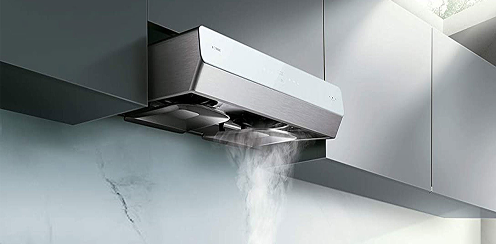
A traditional hood sits flat above the cooktop and waits for smoke to rise into it. FOTILE hoods use a Capture Shield that sits low and close to the burners. Air speeds up as it curves around the shield (known as the Coanda effect), so smoke gets pulled in before it drifts past the edges. This close capture covers 6 to 7.2 square feet of cooktop.
Three numbers tell you how well a hood ventilates:
- CFM (cubic feet per minute): How much air the fan moves.
- Static pressure: How hard the fan can push against the resistance in your duct. The higher it is, the more airflow the hood keeps through long runs and elbows.
- Sones: How loud the hood sounds. One sone is about the hum of a quiet fridge, and 2 sones sounds twice as loud as 1.
Grease gets handled differently, too. Our dual motors spin grease out of the air and collect it on the Capture Shield and oil cup, separating 94 to 95% of it depending on the model.
Here's how our series compare. Certified CFM comes from a standard lab test (HVI, now run by AHAM), the same one other brands use. Max Equivalent CFM is our rating for how our close-capture design performs compared to a traditional hood.
| Series | Certified CFM (Top Speed) | Max Equivalent CFM | Max Static Pressure | Noise, Low to High |
|---|---|---|---|---|
| Pixie Air (UQG3002, UQG3602) | 600 | 850 | 410 Pa | 1.2 to 6.0 sones |
| Classic (JQG7501, JQG9001) | 520 | 850 | 400 Pa | 1.2 to 6.0 sones |
| Prestige and Prestige Performance (JQG7505, JQG7507) | 580 | 1,000 to 1,100 | 540 Pa | 1.2 to 7.5 sones |
| VentiCore (JQG7515, JQG9015) | 669 | 1,250 | 1,030 Pa | 1.1 to 7.0 sones |
| Perimeter Vent (EMG7508, EMG9008S) | 651 | 1,200 | 1,000 Pa | 1.0 to 8.0 sones |
Have a long duct run or cook with high heat often? VentiCore and Perimeter Vent have the most static pressure, so they hold their airflow best when the duct path gets complicated.
1. Convertible Range Hoods
Depending on your kitchen's layout, you may prefer a ducted or ductless range hood. A ducted hood sends smoke, heat, and moisture outside. A ductless hood catches grease first, then pushes air through charcoal (activated carbon) filters to remove odors before sending it back into the kitchen. Our charcoal filters use 20mm thick, flame retardant activated carbon cotton. Additional specs include:
- Polyurethane foam
- Carbon content ≥ 50%
- Pore -10
Ductless is the right call when there's no way to vent outside, like in many condos and apartments. It does come with tradeoffs. Charcoal filters remove odors, but they can't remove heat, moisture, or combustion gases from a gas range, and they need replacing. There's also no standard test for recirculating airflow, so the CFM and noise ratings we list are measured with the hood ducted. If you cook on gas or sear often, venting outside is worth the extra work.
Recirculation Kit User and Installation Manual

Our FOTILE Pixie Air® is convertible, offering both ducted and ductless options. The recirculation kit installation process is as follows:
- To avoid misalignments, install the range hood exhaust duct first
- Next, use aluminum foil tape to wrap the exhaust cover
- Then, insert the recirculation kit into the exhaust cover (use a 45° angle)
- Once inserted, seal the aluminum foil tape
- Lastly, use another segment of aluminum foil tape to seal the exhaust cover again
Before installing your recirculation kit, measure your upper cabinet height from the base of your cabinet.
For measurements over 15 inches, the regular exhaust vent included with your hood will work. If your measurement is between 12 and 14 inches, you'll need a short exhaust cover, which you can buy with the recirculation kit.

[Pixie Air® Ductless Demo]
For your own safety, be sure to:
- Turn off the circuit breaker leading to your range hood before installing or maintaining your recirculation kit
- Wear gloves to avoid cuts and scratches when changing the charcoal filter
- Keep your upper cabinet door open when operating the recirculation kit
If you use your hood regularly, replace the charcoal filters every four to six months. Replace both at the same time, and don't try to clean them. You can order new ones through our range hood collection. The Capture Shield plates are a different story: they pop off and go right in the dishwasher.
2. Vertical & Horizontal Ducts
Replacing an over-the-range microwave? Most vent through a 3 ¼" x 10" rectangular opening in the wall behind the unit. Pixie Air's horizontal outlet matches that size, so you can use the existing opening instead of cutting a new one. For vertical venting, it connects to a 7-inch round duct through the cabinet above.

[Vertical Ducts]

[Horizontal Ducts]
Airflow stays nearly the same either way. Horizontal venting runs a little louder at higher speeds:
| Fan Speed | Vertical CFM | Horizontal CFM | Vertical Sones | Horizontal Sones |
|---|---|---|---|---|
| 1 | 240 | 240 | 1.2 | 1.5 |
| 2 | 370 | 370 | 2.5 | 4.0 |
| 3 | 470 | 460 | 4.0 | 5.5 |
| 4 | 600 | 590 | 6.0 | 8.0 |
These are lab ratings. In your kitchen, every extra foot of duct and every elbow adds resistance, which lowers airflow and makes the fan work harder and louder. To get the most from any hood:
- Use the duct size listed in your manual and never step it down.
- Use rigid metal duct, not flexible foil.
- Keep the run short, with as few elbows as possible.
Planning your duct path? Our installation guide walks through it step by step.
3. HOA CFM Compliant
Many local codes, including those based on the International Residential Code, require make-up air for hoods that can exhaust more than 400 CFM. Make-up air replaces the air your hood sends outside. Without it, a strong hood in a tightly sealed home can't reach its rated airflow and can pull exhaust back in from gas appliances like a water heater or furnace.
That's why our Pixie Air® has CFM Adjustment Technology (CAT). Your installer can cap the maximum airflow at 400 CFM or lower to stay under that limit. If you want the hood's full power, add a make-up air system where your code allows it.
See how it works in our CAT setup and self-check video.
Find the Right FOTILE Range Hood for Your Kitchen
Start with two numbers:
- Width: Choose a hood at least as wide as your cooktop. Three extra inches on each side captures more smoke.
- Airflow: For gas, plan on 100 CFM for every 10,000 BTUs across all burners, so a 60,000 BTU range needs about 600 CFM. For electric, multiply your cooktop width in inches by 10, so a 30-inch cooktop needs about 300 CFM.
When comparing brands, check these numbers against certified CFM. Our range hood size guide covers width and clearance, and our CFM guide walks through the math for your cooktop.